Every matter, deeply understood
Matter data enters FernLex. Atlas builds a structured, matter-level understanding — and surfaces what matters most: missing information, risks, relationships, and next actions. This is matter intelligence, not document Q&A or legal research.
Matter Intelligence
Deep matter analysis — cross-doc reconciliation, risk scoring, timeline
No blockers — strong
All required docs in
Data matches across docs
12 open · 6 overdue · 24 total
Risk flags
2 critical4 critical tasks due within 7 days — document collection, I-130 preparation, affidavit drafting, USCIS filing.
9-month DOB discrepancy between case data (April 15, 1991) and medical exam (January 15, 1992).
The transformation
See the matter, not just the files
Raw documents, emails, and filings enter FernLex. Atlas reads every one — then builds a structured understanding your team can act on.
What enters FernLex
Documents
Contracts, certificates, records
Emails
Client threads, court notices
Filings
Court forms, applications, receipts
Evidence
Affidavits, support letters, exhibits
Meeting recordings
Consultations, calls, transcriptions
Calendar
Appointments, deadlines, hearings
Client notes
Intake notes, preferences, history
Matter notes
Internal case memos, observations
What Atlas produces
Matter Overview
Atlas · analyzed 2m agoDocuments 1-7 describe a marriage between Michael Carter (Jordanian national) and Mary Johnson (U.S. citizen), while documents 8-9 describe an entirely different marriage between Daniel Brooks (U.S. LPR) and Emily Carter (Pakistani national), married in Lahore in 2018.
Key findings
Documents 8-9 describe an entirely different marriage — Daniel Brooks (U.S. LPR) married to Emily Carter (Pakistani) in Lahore, 2018 — contradicting the Mary Johnson/Michael Carter marriage.
Beneficiary identified as 'Daniel Brooks' in the case designation but as 'Michael Carter' (Jordanian, born 1991) in documents 2 and 7.
Joint lease (document 4) contains placeholder text — 'Tenant Landlord' — undermining its value as proof of shared residence.
+ 4 more findings
Completeness Intelligence
Every matter scored, tracked, and monitored
Atlas continuously scores your matter across completeness, document coverage, consistency, tasks, meetings, and communications — surfacing gaps before they become problems.
Overall Completeness
Across all categories
Completeness
Document Coverage
Consistency
Documents uploaded & analyzed
Data matches across documents
open / overdue / total
processed / pending
action-required / urgent
What Atlas detects
Completed items
All required fields, documents, and signatures are present and verified.
Missing information
Required fields left blank, documents not uploaded, or signatures pending.
Inconsistencies
Conflicting data across documents — dates, names, or amounts that don't match.
Email Intelligence
Emails classified, deadlines extracted, and action items linked to the matter.
Calendar & Deadlines
Court dates, filing deadlines, and task due dates tracked with escalation chains.
Case Notes Intelligence
Meeting notes, observations, and case memos analyzed for key insights and action items.
Upcoming deadlines
Tasks and filings approaching deadline — flagged before they become overdue.
Risk Intelligence
Catch issues before they become problems
Atlas continuously scans for risks across documents, deadlines, and case data — flagging issues by severity so your team can address them proactively.
Critical Risks
Issues that require immediate attention — missing deadlines, conflicting facts, or compliance violations.
- Deadline approaching in 24 hours
- Conflicting dates across documents
- Missing required signature
High Priority
Important items that should be addressed soon — incomplete fields, pending uploads, or review required.
- Document pending review
- Client contact information missing
- Financial records incomplete
Medium Priority
Items to monitor — optional fields, suggested improvements, or best practices to follow.
- Optional field could strengthen case
- Similar past matter had different outcome
- Additional evidence recommended
I-130 Filing Deadline
Sep 30, 2026
All documents approved — critical data errors must be corrected before filing.
Testing Task Due
Sep 29, 2026
Placeholder task tracked one day before the filing deadline.
Only one placeholder task exists — no filing preparation tasks are tracked for a deadline in 2 days.
Michael Carter born in Amman, Jordan
Source: Michael Carter passport.png
Marriage solemnized — Los Angeles County
Certificate No. 2023-157894
2023 tax return filed
12 months after the standard deadline
I-130 filing deadline
In 2 days — no filing preparation tasks tracked
Consolidated automatically from 9 documents · every event linked to its source
Date of birth mismatch between case record and supporting documents
Required contact information missing from case management system
Filing deadline approaching — supporting documents not yet uploaded
Address format differs between documents (Suite 400 vs. #400)
Gap Detection
See what's missing on every matter
Atlas identifies gaps in documents, client information, and case data — then automatically requests what's needed to move forward.
Documents
Financial records
Required for case evaluation
Supporting letters
Strengthens case position
Previous filings
Historical context
Client Information
Emergency contact
Required by regulation
Current address
Needed for service
Employment history
Supports case narrative
Case Data
Case strategy notes
Internal documentation
Conflict check
Ethical requirement
Retainer agreement
Engagement terms
How Atlas resolves gaps
Atlas detects gap
Scans case data and identifies missing information based on case type and requirements.
Requests from client
Automatically sends secure request via client portal or email with specific instructions.
Document uploaded
Client uploads via secure portal. Vera processes and extracts relevant information.
Case updated
Atlas automatically links document to case, updates completeness score, and notifies team.
See what Atlas sees
Every discrepancy, risk, gap and insight — surfaced automatically from your documents and data.
Client Matter — Contract Dispute
OpenMediumB6E083B8·John Smith·Corporate·Discovery
Overall Score
88%
Completeness
50%
Required fields filled
Document Coverage
100%
Documents uploaded & analyzed
Consistency
85%
Data matches across documents
Tasks
50%
open / overdue / total
Meetings
50%
processed / pending
Communications
50%
action-required / urgent
Atlas found a discrepancy
Cross-DocumentContract effective date is June 2023, but the court filing is dated May 2026 — a 3-year gap. This could indicate an expired agreement or a delayed filing.
Risk Flags2 detected
Contract effective date (Jun 2023) conflicts with filing date (May 2026) — 3-year gap flagged for review
Cross-referenced: Contract.pdf vs Receipt_Notice.pdf
Date of birth on case record does not match supporting identification documents
Cross-referenced: Client ID scan.png vs case record
Timeline4 events
Today
AIAtlas completed full-matter analysis
7 documents cross-referenced, 2 discrepancies flagged, 6 action items generated
Aug 18
Documents uploaded and processed
7 files received via client portal and Iris agent — OCR and entity extraction complete
Aug 16
Court notice received
Receipt_Notice.pdf filed — case status updated to Discovery
Jun 2023
Contract executed
Agreement between parties filed in Los Angeles, California
Evidence
7 docs · 7 insightsContract.pdf
Contract
Client ID scan.png
Identification
Spouse ID scan.png
Identification
Medical_Records.pdf
Medical Record
Receipt_Notice.pdf
Court Notice
bank statement.png
Financial
Lease_Agreement.pdf
Lease
Next Steps — AI Generated
by Atlas · todayContract (Jun 2023) vs filing (May 2026) — confirm correct dates with client
Case record shows different date of birth than ID documents
Confirm contract terms still apply given 3-year gap to filing
Client
John Smith
Matter Details
Atlas Summary
Matter is 88% understood. 7 documents analyzed, 2 risks flagged, 3 action items generated. Consistency at 85% — date discrepancy requires attorney review.
Temporal intelligence
Timeline and next steps
Atlas tracks every event in a matter chronologically — and recommends the highest-impact next actions based on deadlines, risk, and completeness.
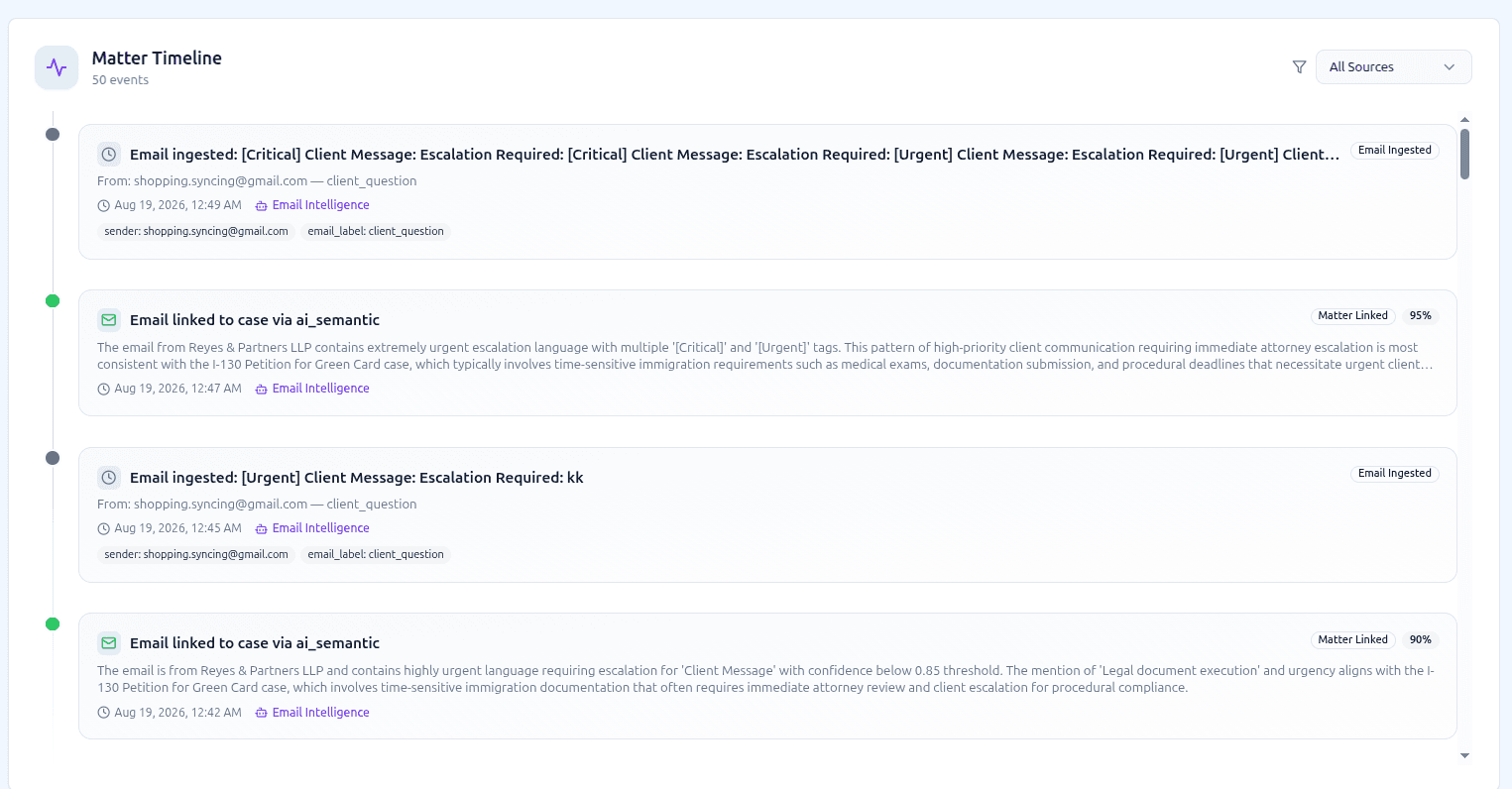
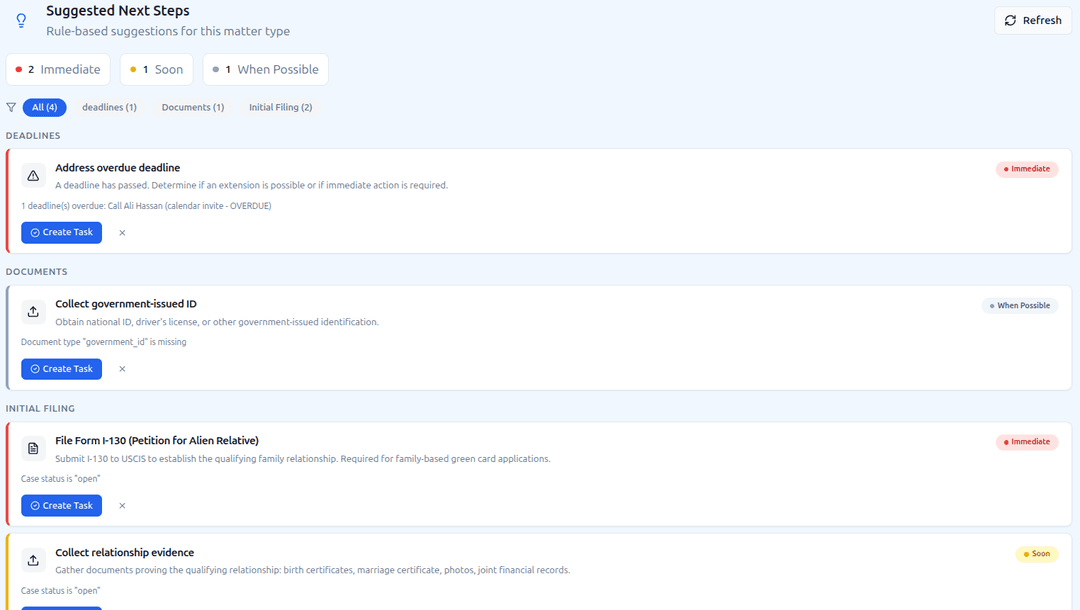
Matter Document Digest
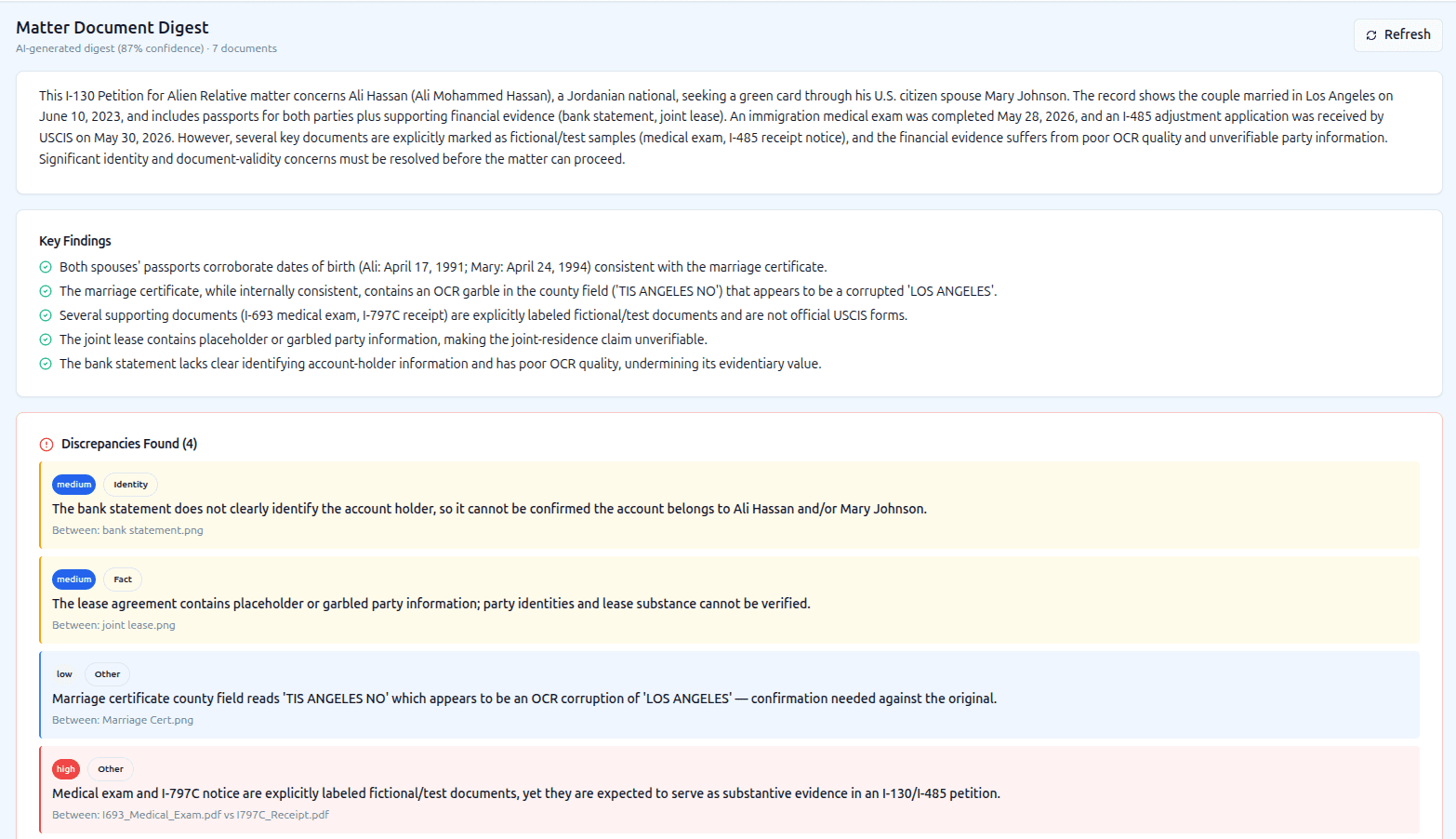
AI-generated digest of the entire matter
Atlas reads every document, cross-references facts, and produces a comprehensive digest with key findings, discrepancies, risk flags, and open questions.
Client Matter Digest
AI-generated digest (87% confidence) · 7 documents
This matter concerns the primary party, seeking resolution through a supporting party. The record shows the parties executed an agreement in Los Angeles on June 10, 2022, and includes identification documents for both parties plus supporting financial evidence. Supporting documentation was completed May 28, 2024, and an application was received by the relevant authority on May 30, 2024. However, several key documents are explicitly marked as drafts/samples, and the financial evidence suffers from poor OCR quality and unverifiable party information. Significant identity and document-validity concerns must be resolved before the matter can proceed.
Key Findings
Both parties' identification documents corroborate dates of birth consistent with the filed agreements.
Primary contract contains an OCR artifact in the address field that appears to be a corrupted entry — verification against original recommended.
Several supporting documents are explicitly labeled as drafts or samples and may not be suitable as official evidence.
Financial evidence lacks clear identifying account-holder information, undermining its evidentiary value.
Joint agreement contains placeholder party information, making the claim unverifiable.
Discrepancies Found (4)
Financial statement does not clearly identify the account holder, so it cannot be confirmed the account belongs to the primary party.
Joint agreement contains placeholder or garbled party information; party identities and substance cannot be verified.
Contract address field reads corrupted text which appears to be an OCR error — confirmation needed against the original.
Supporting documents are explicitly labeled as drafts/samples, yet they are expected to serve as substantive evidence.
Document Inventory (7)
Joint Agreement
Joint residence agreement; extracted content incomplete with placeholder/garbled party info, substance unverifiable.
agreementFinancial Statement
Bank statement (recent period, ending balance visible); poor OCR, lacks clear account holder identification.
financialSupporting Document
Supporting evidence file; explicitly a sample/draft, not official.
supportingPrimary Contract
Main agreement between parties; county field garbled in OCR scan.
contractReceipt Notice
Confirmation of filing receipt; explicitly a test document, not official.
receiptParty ID Document
Identification document for primary party; evidence of identity and status.
identificationSecondary ID Document
Identification document for secondary party; evidence of identity and nationality.
identificationConsolidated Timeline
Primary party born.
Source: Contract / ID Document
Secondary party born.
Source: Contract / ID Document
Primary party identification document issued.
Source: ID Document
Secondary party identification document issued.
Source: ID Document
Parties executed agreement in Los Angeles, California.
Source: Primary Contract
Start of financial statement period.
Source: Financial Statement
End of financial statement period (ending balance visible).
Source: Financial Statement
Supporting documentation completed and filed.
Source: Supporting Document
Application received by relevant authority.
Source: Receipt Notice
Receipt confirmation issued.
Source: Receipt Notice
Parties & Roles
Primary Party
Applicant
Principal applicant in this matter
from ID Document
Secondary Party
Sponsor
Supporting party (citizen/resident)
from ID Document
Risk Summary (4)
Core supporting documents are marked as drafts/samples — could invalidate the filing if relied upon as authentic evidence.
Source: Supporting Document
Receipt notice explicitly states it is not an official notice, challenging the proof-of-filing evidence.
Source: Receipt Notice
Financial evidence has poor OCR quality and unverifiable account holder identity, weakening support claims.
Source: Financial Statement
Joint agreement substance unverifiable due to placeholder/garbled party information.
Source: Joint Agreement
Obligations Summary
Monitor for future notices including appointments and requests for evidence; no action currently required.
Gaps & Open Questions
Gaps Identified
Missing — completed/officially signed copy of the primary filing form
Missing — official filing evidence / notice
Missing — identification documents for both parties (long-form, with supporting details)
Missing — official supporting documentation from approved providers
Missing — financial support evidence / affidavit
Joint agreement lacking legible party identification
Financial statement lacking account holder name and statements spanning a longer period
Missing — joint financial records
Missing — additional supporting evidence (photos, correspondence, joint bills)
Open Questions
Is this matter a real filing, or purely a test scenario (given the draft document labels)?
Are genuine, official versions of the supporting documents available and on file?
To whom does the financial account belong, and does it belong to one or both parties?
Who are the actual parties to the joint agreement, and what are their exact names?
Real-Time Intelligence
Analysis as data arrives
Atlas processes documents, emails, and case data the moment they enter FernLex — no batch processing, no delays.
Document uploaded
09:14 AMPassport scan — client record
OCR extraction
09:14 AMName, DOB, nationality extracted
Entity recognition
09:15 AMLinked to client record, cross-referenced with case data
Risk detection
09:15 AMDOB mismatch detected — flagged for review
Email received
09:16 AMCourt notice — deadline reminder
Deadline extracted
09:16 AMFiling due Aug 23 — 3 days

What happens in real-time
Document Processing
OCR, entity extraction, and classification run as documents arrive.
Email Intelligence
Every email is classified, linked to matters, and action items extracted in real-time.
Deadline Monitoring
Court dates, filing deadlines, and task due dates are tracked and escalated automatically.
Risk Scanning
Conflicts, missing data, and inconsistencies are flagged as soon as they appear.
Performance
< 5s
Document processing
Per document
< 1s
Email classification
Per email
Instant
Risk detection
As data arrives
Real-time
Completeness update
Continuous
Cross-matter intelligence
Patterns across your entire caseload
Atlas does not just understand individual matters — it finds connections, conflicts, and patterns across every case your firm handles.
Shared entities
Names, dates, and organizations that appear across multiple matters — linked automatically.
Conflicting positions
When a fact in one matter contradicts a fact in another — surfaced before it becomes a problem.
Related precedents
Past matters with similar facts, outcomes, and strategies — available as context for current cases.
Common questions about Atlas
Onematterpicture,fourfocusedsystems.
Matter Intelligence sits on top of evidence, inbox, meetings, and intake — each one feeds the same live view of the case.
Every matter analyzed, every risk flagged, every gap surfaced.
Atlas reads every document and email linked to a matter, keeps a live picture of the matter, and proactively surfaces what matters most — with an owner and a status on every open item.